a consistently mild climate, lush nature framing breathtaking landscapes, unspoilt villages and fairy-tale coastlines. A destination for the soul, the eyes and the palate.
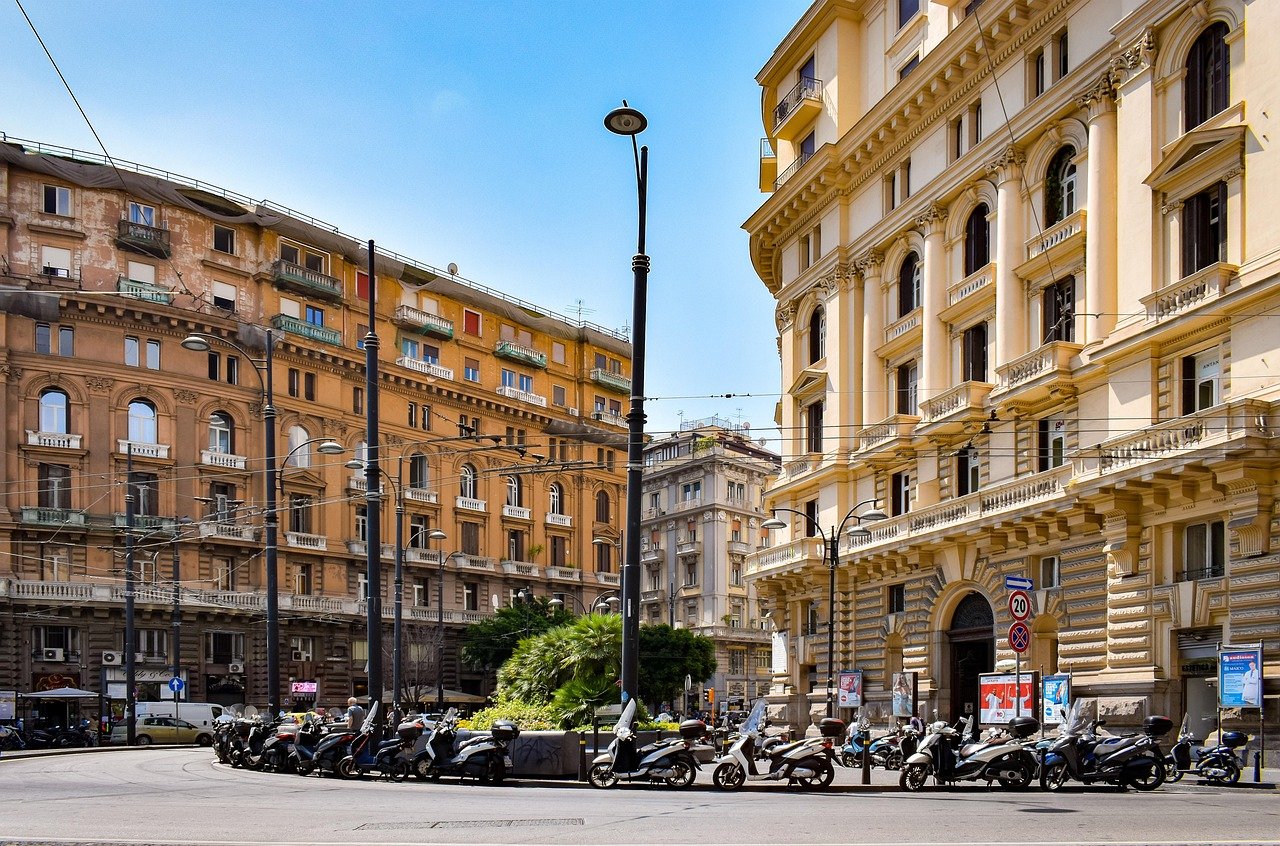
NAPOLI: from its charming waterfront under the shadow of Vesuvius, to its beautiful and bustling historic centre: Naples is a stunning city.
Piazza del Plebiscito, in the western part of the city centre, welcomes you with the symbolic embrace of the iconic colonnade in which the Royal Papal Basilica of San Francesco di Paola is set, one of the most important examples of Neoclassical architecture in Italy. On the opposite side of the square stands the imposing Royal Palace, the historical residence of the Spanish viceroys. The complex includes the picturesque gardens, the Vittorio Emanuele III National Library with over 1 million volumes and the San Carlo Theatre. Founded in 1737, the San Carlo is the oldest opera house in the world still in operation.
Lose yourself along Via Toledo, one of the most important streets in Naples and one of the main commercial thoroughfares. Built alongside the ancient city walls in 1536, it connects Piazza Trieste e Trento with the imposing Piazza Dante, crossing the city from north to south.
The Cathedral, the name given to the Metropolitan Cathedral of Santa Maria Assunta, is a glorious example of Gothic, Baroque and Neo-Gothic architecture and one of the most important religious buildings in the city. On the inside, you cannot miss the Museum of the Treasure of San Gennaro, which preserves sacred and valuable objects related to the cult of San Gennaro. The Saint’s relics are venerated here, which is where, three times a year, Neapolitans witness the ritual of liquefaction
Close by is another of Naples‘ treasures, the Sansevero Chapel Museum which hosts the Cristo Velato by Giuseppe Sanmartino, one of the most striking sculptures in the world: a single block of marble which was carved in 1753, depicting the lifeless body of Jesus on which a transparent shroud seems to lie. Walk down Via di San Gregorio Armeno in the same area, and lose yourself among the many craft shops selling cribs.
In Piazza del Gesù Nuovo stands the Baroque obelisk of the Immacolata, the last of the three great obelisks (or spires) of Naples, together with that of San Gennaro, in Piazza Riario Sforza, and that of San Domenico, in Piazza San Domenico Maggiore. The ancient Monumental Complex of Santa Chiara is just a few steps away. Built from 1310 onwards, it is a splendid Franciscan citadel. But the most beautiful part is the cloister covered in brightly coloured 18th-century majolica. If you visit the centre of Naples, you cannot miss the basilica of San Lorenzo Maggiore, one of the oldest in the city, with its monumental complex and 15th century bell tower. The church of San Domenico Maggiore, on the other hand, is a splendid example of Gothic-Angevin architecture. Also not to be missed is underground Naples, with the ancient catacombs of San Gennaro dating back to the 2nd century AD.
The long Neapolitan Walk begins at what can deservedly be considered a must-see among the places to visit in Naples: the Lungomare (waterfront promenade). Stroll along it in the morning, better still very early in the day, and you will be treated to some of the most fascinating scenery you can imagine.
In the 3 km of brisk walk, stretching from Mergellina to Via Nazario Sauro, you can admire all the grandeur of Vesuvius, which dominates the gulf from above. You will encounter the magnificence of Castel dell’Ovo, which seems almost to float on the islet of Megaride; you will catch a glimpse of Capri and the hill of Posillipo. In short, passing along the famous Via Caracciolo, which flanks the Villa Comunale park and the Riviera di Chiaia, you will breathe in the sea breeze and the unpolluted air of a green lung that reaches as far as Piazza Vittoria. In the distance is the Vomero hill.
Shopping time!
If you’re wondering where to go in Naples if you love shopping, this reconnaissance route is for you. Via dei Mille, Via Filangieri and Via Chiaia are a paradise for high-fashion shops.
Street food in Naples is the quintessence of wonders for the palate…
The queen is transformed: here is the pizza a portafoglio and the pizza fritta
The Neapolitan pizza is undoubtedly the city’s icon, so the Neapolitans have invented a way to carry it with them. The pizza a portafoglio (‘wallet pizza’), alternatively, there is fried pizza.
The best places to eat pizza are: 50 Kaló, Sorbillo, Pizzeria Brandi, L’Antica Pizzeria Da Michele. All the Pizza places are good in Naples!
On one side the queen, on the other the king: presenting the cuoppo, the king of street food. The classic cuoppo contains potato croquettes, salted zeppoline (a type of fried dough), fried sciurilli (battered zucchini flowers), mini arancini, fried polenta scraps and pasta fritters.
For those who prefer fish, the frittura di paranza is a must: it’s made with small fish and squid rings, accompanied by battered vegetables. The right place for a perfect cuoppo is the Friggitoria Vomero, an essential area to visit if you are passing through Naples.
The Neapolitan panino doesn’t need a filling: it’s already stuffed
The typical sandwich in Naples is called pagnottiello, and is made of dough flavoured with cheese, pancetta and salami. You cannot say you have tasted the most authentic street food without having eaten one: greasy, delicious and gigantic. The address to take note of is the Antica Friggitoria Masardona.
A no less succulent alternative is the meatball sandwich with ragù. It may sound strange if you are used to only seeing ragù on pasta, but it is worth the experience. The place to go is Tandem.
Neapolitan taralli? Only with lard and pepper
Their history dates to the late 1700s when bakers began reusing leftover dough scraps by adding lard, pepper and almonds and then twisting them before baking. The best places in town to taste them are the Tarallificio Leopoldo and the Taralleria Napoletana. The classic variant is the one with almonds, but there are all kinds.
Pasta and frying go well together: the pasta frittata
The most classic one can be found at Di Matteo’s, while Giri di Pasta has reinvented it by offering it in many variations, all very tasty.
Dulcis in fundo and dulcis in street food: the best typical Neapolitan sweets
You can’t say you’ve been to Naples without asking yourself about the eternal dilemma: sfogliatella riccia or frolla? To dispel the doubt, you have to taste them both several times. Get them from Attanasio, near the station: he bakes them all the time and they are always warm and fragrant. Alternatively, go to Scaturchio’s or Pintauro’s.
The Neapolitan tradition, however, is rich: drop by Carraturo for a babà and you must stop by Poppella, in Sanità, to taste the snowflake, a soft brioche filled with milk cream, cream and vanilla.
COSTIERA AMALFITANA
A sun-warmed jewel, characterised by an unrivalled gastronomic tradition, small towns overlooking the sea and a priceless historical heritage: the Amalfi Coast.
One of the most visited areas of Campania in the world, this stretch of coastline reaching from Positano to Vietri sul Mare along the Tyrrhenian coast of southern Italy. In front is the Gulf of Salerno, behind it the Monti Lattari.
Its high cliffs, enchanting coves and small bays, terraces dotted with citrus fruits, vines and olive trees, and its high-fashion shops and artisan workshops make it one of the most popular destinations in the world.
The most beautiful places to visit on the Amalfi Coast
Six key stops, starting with Positano, colourful houses, churches, flights of steps, narrow streets and tiled roofs framing the town overlooking the sea.
The second, must-see stop is Amalfi, the town that has long held a monopoly on trade in the Tyrrhenian Sea and eastern markets. Its town planning seems to have an oriental influence, with its houses clinging to steep slopes, among labyrinths of alleys and stairways. The Amalfi Cathedral is an almost obligatory stop.
A trip to the ‚first pearl of the Amalfi Coast‘, Vietri sul Mare, is a feast for the eyes: alleys, shops, colourful houses, almost as captivating as its traditional ceramic work. We continue on to Cetara, a fishing village that seems suspended in time.
Villa Cimbrone in Ravello, dating back to the 11th century, is also worth a visit. The villa itself is a private hotel, but it is possible to admire the immense gardens that, thanks to the Terrazza dell’Infinito, have the most beautiful view of the Amalfi Coast.
Typical products of the Amalfi Coast…
The food and wine tradition of the Amalfi Coast is based on typical products of the land, obtained thanks to its optimal climate, the influence of the sea and the characteristic terracing created by man.
Among the must-try products are Amalfi lemons, citrus fruits with Protected Geographical Indication called Sfusati because of their elongated, tapered shape.
The wine of the Amalfi coast is very popular: the area produces a full-bodied and fresh white, a tannic and intense red and a delicate rosé.
True connoisseurs will fall in love with Cetara’s colatura di alici, an amber-coloured liquid condiment with an intense salty flavour used to season spaghetti. Obtained by macerating several layers of anchovies, alternating with other fish, salt and flavourings.
Traditional dishes also include ‚ndunderi, large gnocchi made of semolina and ricotta cheese that are said to date back to Roman times.